Never worked with system levels programming before I have only and always worked with either python or I have used typescript that’s it.
But as of late, as I transition out of Zephyr Cloud, I have become really interested in Rust. The safety, speed, and stability are what are pushing me to use the programming language, and my interest is peaking at the thought of Rust being used for data engineering.
I hear about rust for the first time because of polars

A fast and easy way, and probably way more scalable, to handle large chunks of data, and I am looking forward to it. Before I was using pandas for small to medium amounts of data but once I saw polars I was hooked and I wondered about what language it was well wouldn’t you see that it’s written in Rust. Then it happend I spiraled into the world of rust.
I think the biggest reason I’m learning Rust now is because I met KDY1 — if you don’t know who KDY1 is, you should really check out his work at swc.rs.
He was the one who created SWC (Speedy Web Compiler), which is a blazing-fast compiler and toolchain written in Rust. It’s used by an impressive range of modern JavaScript and TypeScript projects and frameworks:
- Next.js: Uses SWC as its primary compiler, resulting in significantly faster build times.
- Parcel: A web application bundler that utilizes SWC.
- Deno: A secure runtime for JavaScript and TypeScript that integrates SWC.
- Vite: Recommends or uses SWC for TypeScript compilation in certain configurations.
- Remix and Turbopack: Frameworks/tools that have integrated SWC.
Major companies like Vercel, ByteDance, Tencent, Shopify, and Trip.com employ SWC in their development workflows. It’s incredible to see how widely adopted SWC has become in the JavaScript ecosystem!
I had the pleasure of working with this person, so I asked him, in the age of vibecoding and AI, how much code do you really write well? It was interesting he told me that when he writes in languages like typescript or golang he heavily relies on AI just because he doesn’t like working with those languages. I thought to myself That’s respectable. We all have languages we don’t like such as I don’t enjoy working with typescript as much as python. But what he said next I found quite interesting he said that when he writes code in rust he loves the language. It took a me second to realize this but the thing that made kdy1 amazing wasn’t the fact that he wrote the SWC it’s because he coded not for any other reason then the pure joy he has for code. I believe this was my tipping point I started looking into rust and now I am fully hooked so Ill stepping foot into the world of system level languages.
My First Steps
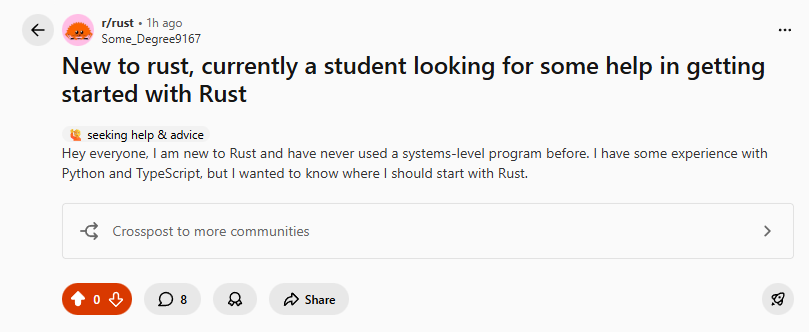
I asked people on Reddit for advice, and for anyone looking to learn Rust in the future, I highly recommend checking out the r/rust community. This community is amazing and super supportive—unlike a few webdev framework communities, which shall go unnamed. So please, talk to people and learn from them.
I’m kicking off my Rust journey by diving into The Rust Programming Language Book. since it was the biggest thing recommended to me by everyone.
Another thing I’m looking into to work with while I learn is Rustlings.
If you haven’t heard of it, Rustlings is a great collection of small exercises that are designed to help you get comfortable with Rust’s syntax and core concepts in a very hands-on way. You can set it up by following the instructions at rustlings.rust-lang.org/setup.
I’ll be working on these exercises alongside reading The Rust Programming Language book. I feel like this combo—reading theory and practicing with real code—will really help solidify my understanding.
I’m eager to start and will keep everyone updated on my journey as time goes on! This will be great as an experience to learn